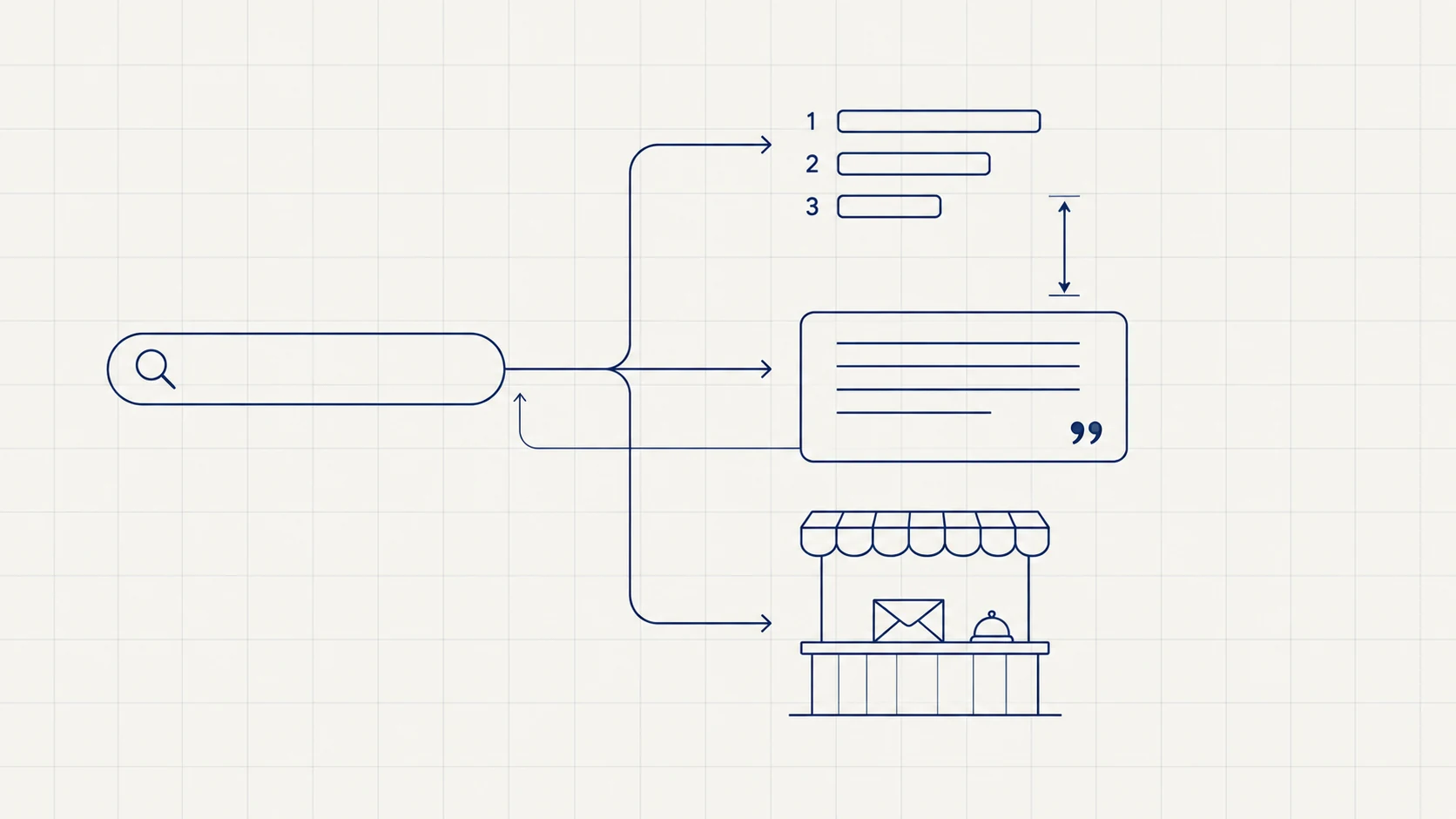
Somebody searches for what you sell. They read an answer. They never visit your website. And then they call you.
That sequence is now normal, and it breaks how most businesses judge whether their website is working. Traffic goes flat or falls, so the site "isn't working" — while the enquiries it produced arrived through a phone call nobody attributed to it.
This is what everyone means by AEO, and why the old scoreboard stopped measuring the game.
What is AEO, and how is it different from SEO?
SEO gets you into the list of results. AEO gets you quoted in the answer above it.
Answer Engine Optimisation is the work of being the source an AI system cites when it answers a question — Google's AI Overviews, ChatGPT, Gemini, Perplexity. You are not trying to win a click. You are trying to be the business the answer is built from, named in it, so the reader arrives already knowing who you are.
They are not rivals. Classic ranking is still the gate: analysis by Ahrefs of over a million ChatGPT prompts found the pages it cites are heavily drawn from what already ranks. AEO is a change in what you optimise for — being quotable rather than being clicked.
Is SEO dead in 2026?
No, but the click is dying, and you should plan for that rather than argue with it.
The cleanest measurement is from the Pew Research Center, which watched what 900 people actually did across nearly 69,000 real searches (published July 2025). When Google showed an AI summary, people clicked a normal result in 8% of searches. Without a summary, 15%. Clicks on the links inside the summary: 1%.
Read that as the new arithmetic of search. Roughly half the clicks are gone on questions that AI can answer, and the visibility did not go anywhere — it moved into a panel that mentions you without sending you a visitor.
For a business selling a considered purchase — an ERP, a website, a POS, a fit-out — this matters less than it does for a publisher selling ads. You were never going to close a deal off one pageview. You needed to be seen, trusted and remembered at the moment somebody was deciding. That still works. It just stopped producing a number in your analytics.
What does Google actually reward now?
Content that isn't a commodity. This is not our opinion — it's the distinction in Google's own guide to generative AI features, published in May 2026, which contrasts:
"Commodity content (for example, something like '7 Tips for First-Time Homebuyers') is often based on common knowledge"
with
"Non-commodity content (such as 'Why We Waived the Inspection & Saved Money') provides unique expert or experienced takes that go beyond common knowledge and the ordinary."
That one paragraph is the whole strategy. "5 benefits of ERP software" is a commodity; a thousand pages say it and no system needs yours. "What we quoted for a three-outlet restaurant and what changed the price" exists nowhere else.
And on the question every business asks us: no, Google does not penalise AI-written content. Its spam policies target scaled content abuse — "many pages generated for the primary purpose of manipulating search rankings and not helping users" — and say it applies to unoriginal, low-value content "no matter how it's created." Use AI to edit and structure. Do not use it to supply experience it doesn't have.
What most SEO advice still tells you to do, and shouldn't
Several tactics still sold in India as packages are simply obsolete:
| Still being sold | What's actually true |
|---|---|
| FAQ schema for rich results | Google retired the FAQ rich result in May 2026 and deleted the documentation in June |
| "Write 2,000+ words to rank" | Google says there is no word count target. In Ahrefs' study of 174,000 AI-cited pages, 53.4% were under 1,000 words |
Publish an llms.txt file |
Google states it doesn't affect visibility. Ahrefs found 97% of such files were never requested at all |
| "E-E-A-T is a ranking factor" | Google's own documentation says plainly that it is not |
| Schema markup lifts rankings | It controls how results appear. It is not a ranking lever |
None of this is hidden. It is all in Google's public documentation, which is why you should ask any agency quoting you an "SEO package" which of the above they're charging for.
How do you get an AI to cite your business?
Be the page that answers one specific question, near the top, with numbers.
Three things carry most of the effect, and they are all structural:
- Make the heading the question. Analysis of half a million retrieved pages found that when a page's heading closely matched the question asked, it was cited far more often than when it didn't. Write
What does a website cost in India?, notOur pricing philosophy. - Answer in the first sentence under that heading. Citations cluster heavily in the first third of a page. An answer buried under four paragraphs of preamble doesn't get quoted.
- Publish real figures, in the text. The one peer-reviewed study in this field — from Princeton and IIT Delhi, presented at KDD 2024 — tested nine tactics and found adding statistics and citing sources performed best, while keyword stuffing performed worse than doing nothing.
Narrow beats comprehensive. One page that answers one question completely will be cited more than a 4,000-word "ultimate guide" covering twelve.
One encouraging finding for smaller businesses: being a big domain matters less here than it does in classic search. In the same ChatGPT analysis, roughly three-quarters of citations went to sites well outside the heavyweight tier. You cannot outrank a national portal on "ERP software" — but you can absolutely be the page that answers "what does a custom ERP cost for a distributor with three godowns".
What kind of blog post actually brings enquiries?
The ones written for someone already deciding, not someone idly learning.
In order of how reliably they produce conversations:
- Price and cost posts. What it costs, what changes the price, what you pay afterwards. Buyers search this more than anything else and most competitors refuse to answer it.
- Comparison and threshold posts. Tally or a custom ERP. Shopify or a built store. When to switch, with the numbers that tell you it's time.
- "When you shouldn't hire us." Counter-intuitive and effective: naming who you're wrong for makes everything else you say more believable, and it filters out the enquiries that waste both sides' time.
- Your own projects, told honestly. What broke, what it cost, what you'd do differently.
Then make it easy to reply. For most Indian businesses, that means WhatsApp, not a contact form — the owner reading your post at 10pm will send a message, not compose an email. One clear ask per post, in the body and at the end, is worth more than three competing buttons.
How long before this produces leads?
Longer than anyone selling it will tell you.
Ahrefs' measured data on new pages is sobering: only 1.74% reach Google's top 10 within a year, and 72.9% of pages currently in the top 10 are more than three years old. Plan on three to six months before a post pulls its weight, and twelve before the blog as a whole does.
Which is also the argument against publishing daily. Orbit Media's 2025 survey of 808 bloggers found those spending six or more hours on a post were about twice as likely to report strong results. One post a week that only you could have written beats five that anyone could.
How do you measure it when nobody clicks?
Change the scoreboard, or you'll switch off the thing that's working.
- Ask every enquiry how they heard about you. One open text field. At your volume this is more accurate than any analytics tool — and analytics will under-report AI referrals badly.
- Watch impressions, not just clicks, in Search Console. Impressions without clicks still means you were the source.
- Track searches for your own name. If content is working, more people look you up directly. That survives the zero-click era intact.
- Judge enquiry quality, not volume. The point of publishing your prices is that the people who contact you have already accepted them.
Ignore pageviews, bounce rate and domain authority. At the volume a growing business does, none of them are telling you anything you can act on.
Where to start, this week
- Claim your Google Business Profile if you haven't. For a local business it still outperforms everything on this page, and it's free.
- Write the price post for the one thing you most want to sell. Put a real range in it.
- Re-title the pages you already have so their headings match the questions people actually ask.
- Put a WhatsApp link on the posts that matter, and see what arrives.
That's the whole method, and you can run it without hiring anyone. We publish our own price ranges for exactly this reason — it's the post we'd want to read if we were the one deciding.