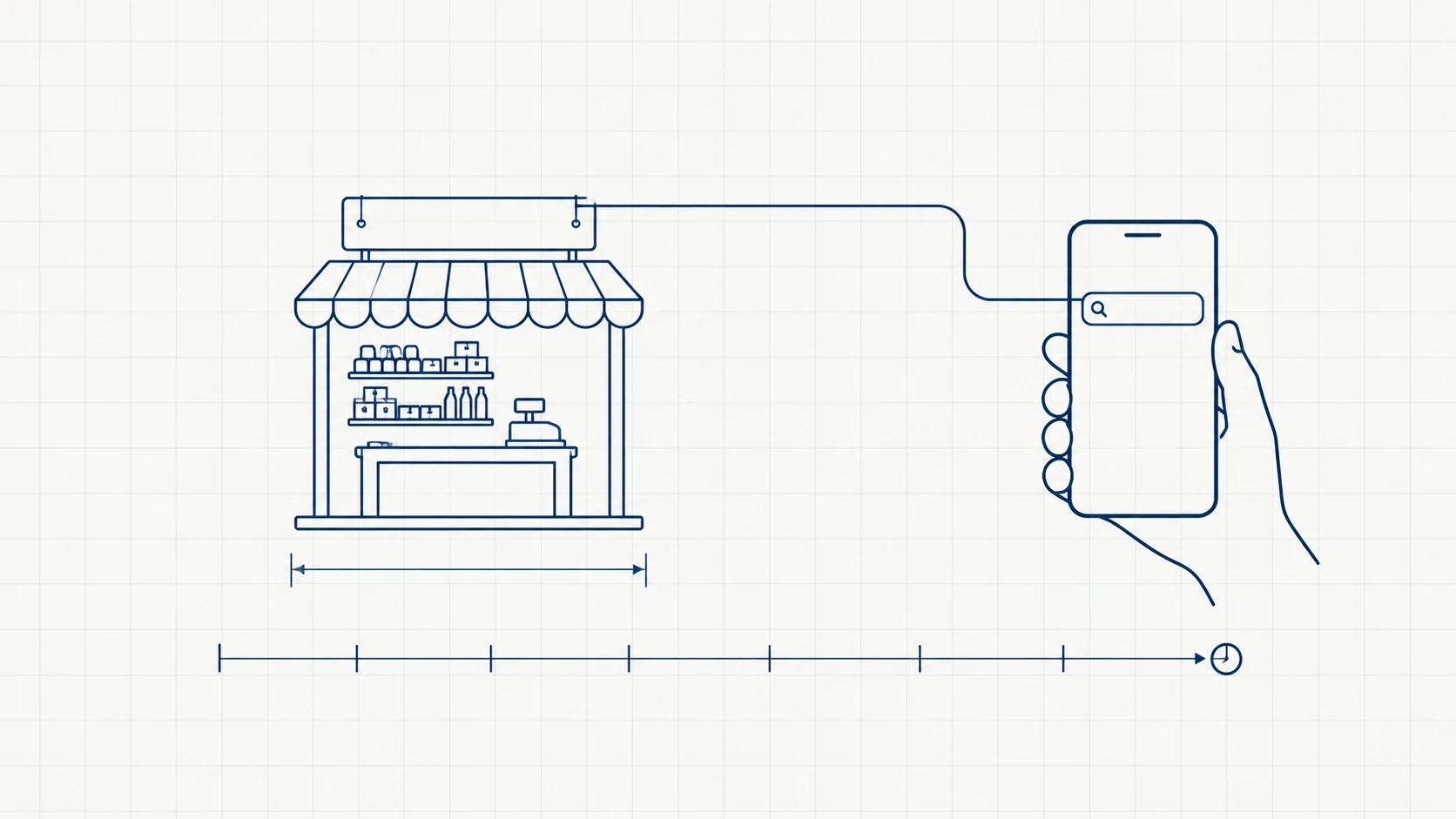
The objection always arrives in the same shape. Four hundred customers on WhatsApp. Orders coming in through Instagram. The shop full on Saturdays. So why pay for a website?
It's the right question, and most of the answers given to it are rubbish — "every business needs an online presence", "your competitors have one". Neither of those is a reason. So here is the honest version, including the part where the answer might be no.
What actually happens before someone buys from you
Somebody hears about you. A friend mentions your name, they see your board from the road, a card ends up in their hand, they find your Instagram.
Then, almost always, they search your name. Not to browse — to check. Are these people real? How long have they been doing this? Where are they? What do they cost? Will I be annoyed if I go there and it's closed?
That check takes eight seconds and it decides everything. What they find at that moment is the whole game, and right now, for most small vendors, what they find is somebody else's platform: an Instagram grid with no prices, a Justdial listing you don't control, a review from 2019, or nothing at all.
The point of a website is not traffic. For a small vendor it's almost never traffic. The point is that the eight-second check ends well, on something you own.
Do the free thing first
Before you spend one rupee on a website, do this, this week: claim your Google Business Profile.
It's free. It puts you on Maps, it shows your hours, your phone, your photos and your reviews, and for a local business it is the single highest-return thing available. A sweet shop, a workshop, a clinic, an electrician — for all of them the Google listing outperforms the website, because it appears at the exact moment somebody nearby is searching for what they sell.
Fill it properly: real photos (not stock), correct hours including holidays, the actual services, and ask your regulars for reviews. Then reply to the reviews.
If you do nothing else after reading this, do that. Anybody who sells you a website without asking whether your Google listing is claimed is not looking after you.
So when does a website earn its place?
Five situations. If none apply, you can wait.
When what you sell needs explaining. A price list is fine on Instagram. A process — custom work, fabrication, installation, anything with sizes, materials and timelines — needs a page somebody can read at 11pm without messaging you.
When you're being compared. The moment you're one of three quotes, the one with a site that shows finished work, real photos and a straight answer on price wins more often. Not because the site is impressive. Because the other two made the buyer guess.
When you're answering the same questions all day. Do you deliver to this area, what are your rates, do you do this size, are you open Sunday. Every one of those answered on a page is time back, every day, forever. This is the most underrated reason and the one vendors feel fastest.
When you want to be found by people who've never heard of you. "Aluminium fabricator in [your area]" is typed into Google every day. Instagram cannot win that search. Your Google listing wins some of it; a page about that exact service wins more.
When the platform's rules start costing you. Reach drops, an account gets restricted, a listing site starts charging to show your number above a competitor's. Every business built entirely on a platform is renting its customers. A site plus a phone list is the part nobody can switch off.
What "a website" means at your size
Not eight pages. Not a blog. Not a chat widget.
One page that loads in under two seconds on a mid-range Android phone with two bars of signal, and answers, in this order: what you sell, proof you've done it (six to ten real photos of actual work), roughly what it costs, where you are, and a tap-to-call button plus a WhatsApp link. Your hours. A map.
That's it. That page is worth more than most ₹1.5 lakh sites, because it's honest about its job — to end the eight-second check well and get the call started.
Two practical points. Build it to load on a bad connection, because that's the connection your customers have. And put the WhatsApp link in, prominently — if that's how your customers already talk to you, don't make the site fight it. The site's job is to get them into the conversation they were always going to have.
What it costs, honestly
You can do this yourself for the price of a domain — around ₹1,000 a year — on a page builder, in a weekend. Plenty of vendors should. If you're comfortable with a phone and have decent photos of your work, this is a genuinely good use of a Sunday.
Paying someone gets you better structure, better photos and copy that sells, and starts around ₹15,000 – ₹60,000 for a template build. We've written the full breakdown of the bands and what moves them in what a business website actually costs in India.
The thing worth paying for, whichever route you take, is photography. Ten good photos of your own work will do more for a small vendor than any amount of design. Most vendors have this backwards and spend on the design while using blurry photos taken at the wrong time of day.
When the answer is no
Don't build one yet if:
- You're still working out what you sell. A site describing last quarter's business is worse than no site.
- You have nothing to show. No photos of finished work, no reviews, no prices you'll commit to. Build the proof first — the site is a place to put proof, not a substitute for it.
- Your Google listing isn't claimed. Do that first. You may find it's enough for another year.
- You can't keep it current. A site with last year's prices and a dead phone number is actively worse than nothing. It fails the eight-second check instead of passing it.
For everyone else: one honest page, your own domain, real photos, and a phone number that rings. That's the whole requirement. Anyone quoting you for much more than that should be able to say exactly which of the five situations above they're solving.