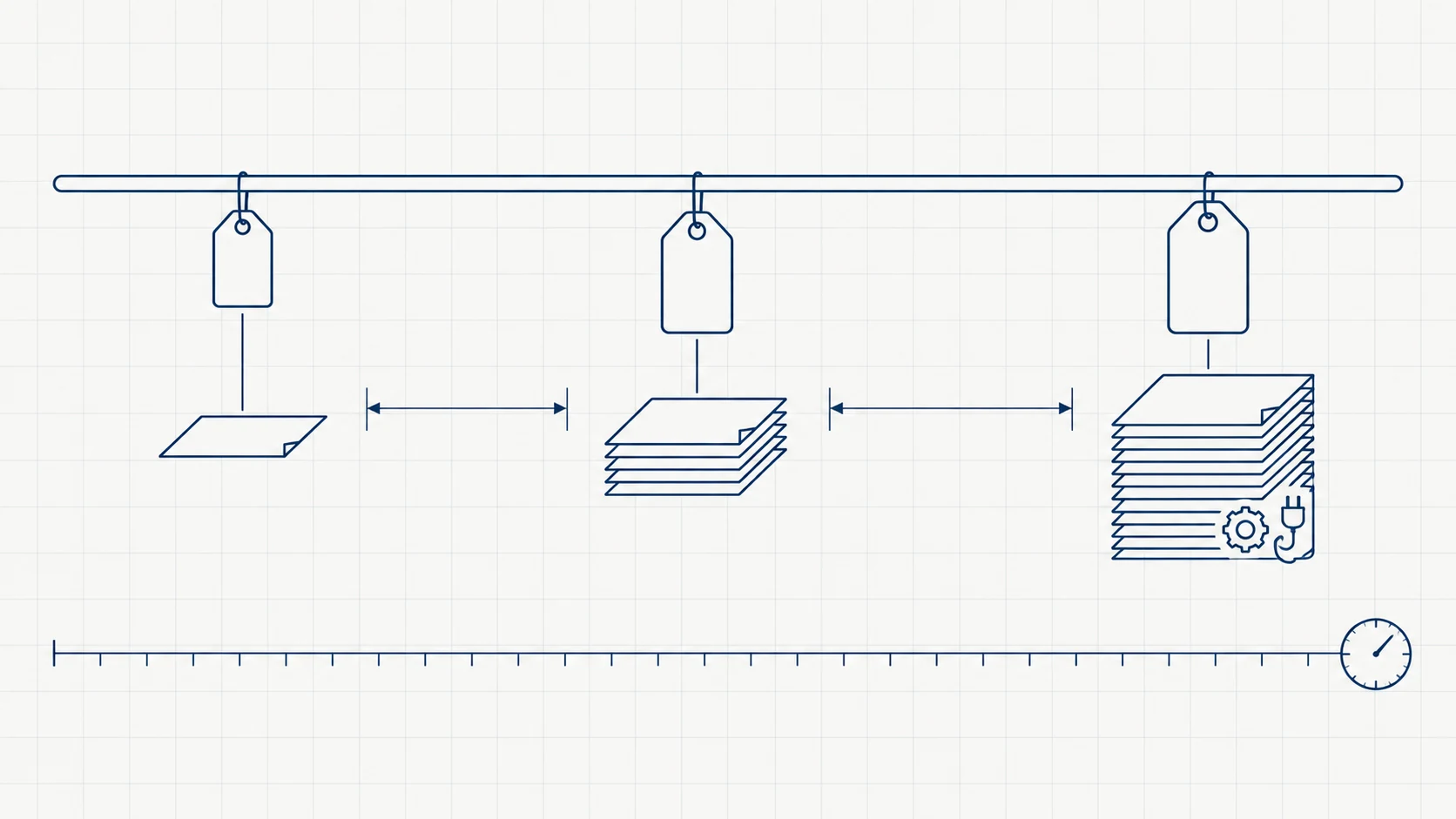
Nobody publishes their prices, so everybody guesses. You ask three agencies for a website and get ₹40,000, ₹3 lakh and ₹11 lakh — for what sounds, in the email, like the same thing.
It isn't the same thing. But the difference is almost never explained, which leaves you picking on gut feel or on the lowest number. This article is the explanation: what each band actually buys, what makes a quote jump a band, what you keep paying after launch, and the cases where the right answer is to spend nothing with an agency at all.
All figures are Indian market ranges we see quoted in 2026, for a business site — not a funded product. Your quotes will land somewhere in them.
The three bands
₹15,000 – ₹60,000. A template, configured. A bought theme on WordPress, or Wix, Squarespace, Framer. Your logo, your colours, your text dropped into someone else's layout. Five to eight pages, a contact form, mobile-responsive because the theme already was.
What you get is a real, working website. What you don't get is anyone thinking about your business. The layout was designed for a generic "agency" or "restaurant", and your content is being fitted to it rather than the other way round. If your competitors bought the same popular theme — and in some sectors they did — you will look like them.
Worth it when: you need to exist online, you need it this month, and the site's job is to be found and to prove you're real.
₹60,000 – ₹3 lakh. Designed for you, built properly. Someone sits down with you before they open a design tool. The structure comes from what you sell and who has to be convinced, the pages are laid out for that, the copy is written or at least seriously edited, and it's built to load fast and be indexed well. A CMS so your team can edit without calling anyone. Eight to twenty pages.
This is where most established Indian businesses should be, and where most of our web work sits. The gap between this and the band below isn't decoration — it's that the site is arguing your case instead of just listing your services.
₹3 lakh – ₹15 lakh+. A site that does a job. Custom design plus real engineering: a store with live stock, a portal customers log into, a booking or quoting engine, multi-language, integrations with the systems you already run. The website stops being a brochure and becomes part of operations.
You are now paying for software, not pages. The price tracks the logic behind the screens, not the number of them.
What actually moves the number
Six things, roughly in order of how much they move it.
- Logic, not pages. Twenty pages of text cost less than one page that checks stock, calculates a price and takes a payment. When a quote surprises you, this is usually why.
- Who writes the words. Copy is the single most-skipped line item and the most common reason a project stalls. If you supply final text, you save money. If you supply "we'll send it next week" for four months, you pay in delay instead.
- Photography. Stock images are free and look it. A day of real photography is ₹15,000 – ₹60,000 and often changes the site more than another ₹1 lakh of design would.
- Integrations. Payments, a CRM, Tally, a courier's API, WhatsApp. Each one is a system someone else controls, with its own documentation, sandbox and surprises. Budget per integration, not as a rounding error.
- Approvals. A decision made by one owner costs less than the same decision made by a committee of five. This is not a joke line item — rounds of revision are where fixed-price projects quietly become expensive for whoever absorbs them.
- Deadline. Compressing three months into six weeks means paying for parallel people. Expect 20–40% for a genuinely hard date.
What you pay after launch
The part nobody quotes, and the part that catches out first-time buyers. Annually:
- Domain: ₹800 – ₹1,500. A
.inor.com, renewed every year, in your account. - Hosting: ₹3,000 – ₹30,000 for a business site. Managed or serverless hosting costs more and fails less.
- SSL: free. If someone is billing you for a basic certificate, ask why.
- Maintenance: ₹2,000 – ₹15,000 a month, depending on what's running. Updates, backups, security patches, small edits. On a WordPress site with plugins this is not optional — an unpatched plugin is the most common way an Indian SME site gets defaced.
- Content and SEO: whatever you commit to. A site that isn't added to stops earning attention within about a year.
A ₹1.5 lakh site with no budget for the year after it is usually a worse investment than a ₹90,000 site with one.
How long it takes
Template, configured: one to three weeks. Designed and built: five to ten weeks. A site with real functionality: three to six months.
Add to any of those the time it takes you to supply content and give feedback, which in our experience is the largest single variable in the whole schedule — bigger than the build.
When you shouldn't hire an agency
Three honest cases.
You're pre-revenue and testing an idea. Build it yourself on a page builder this weekend. Spend the money once you know what the business is. A beautiful website for a business that changes shape in month four is money burned.
Your customers find you on Instagram or WhatsApp and buy there. Some businesses genuinely run on that. You still want a simple site so you're findable and credible — a template is fine. Put the budget into product photography instead.
Your real problem is somewhere else. If orders are being lost between the shop floor and the accounts sheet, a nicer website doesn't fix it. We've told people this and lost the project. It was still the right advice — we'd rather be the people who said it than the people who took ₹2 lakh for the wrong thing.
If you are getting quotes right now
Three things to do before you choose.
- Ask what's excluded. Not what's included — every proposal lists that. Ask about copy, photography, hosting for year one, post-launch fixes and who owns the code. The exclusions are where the gap between ₹40,000 and ₹3 lakh usually hides.
- Get the domain and hosting in your own name. Whatever you spend and whoever you hire. An agency holding your domain is the single most common way businesses get stuck with someone they've outgrown.
- Ask to see something they built two years ago. Anyone can show you a launch. A site that still works, still ranks and has been maintained tells you what you'd actually be buying.
And if you'd rather skip the guessing: tell us what the site has to do and who it has to convince, and we'll put a number on it in writing.